ABG All Board Games
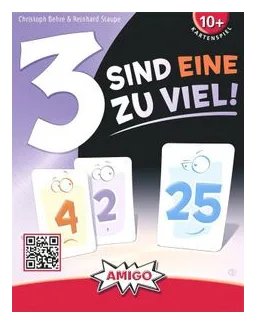
3 Sind Eine Zu Viel! box art

3 Sind Eine Zu Viel!

Players

2-4

Time

?-?

Age

10+

Weight

1.41

Rating

6.50

Fit

Teach 2.4

Teaching signal

Replay 4.1

High replayability

Interaction 3.3

Low interaction

Scaling 4.4

Scales well

Strategy 4.7

Deep strategy

Control 2.8

Luck-sensitive

Table feel

Moderate level of interaction with a mix of direct and strategic confrontation. Players need to pay attention to others' actions frequently, but there is limited emphasis on cooperation.

Replay value

The game 3 sind eine zu viel! has a high replayability score due to its high variability, strategic depth, and adaptability to different player counts. The presence of expansions adds additional content and gameplay elements, further enhancing the replay value. The game offers a fresh experience each time it is played, allowing players to discover new tactics and strategies. While the game may not be the easiest to learn, it strikes a good balance between easiness and depth, making it accessible to a wide range of players.

Luck profile

The final luck score for 3 sind eine zu viel! is 5.67, indicating a balanced mix of luck and strategy. Random elements have a notable but not exclusive impact on the game outcome. Players have substantial ability to mitigate randomness through strategic decisions and planning. The game outcome is primarily determined by player strategy and decisions, with luck playing a minor role.

Overview

Hold back or hurry forward? In 3 sind eine zu viel! (3's a Crowd!), no player escapes this question as they decide which cards to play when. To set up, place the start cards in the middle of the table, then deal a deck of twenty cards to each player. Each player draws a hand of eight cards from their deck. On your turn, play one number card from your hand into the display on the table. Each card you play has a certain place in the numerical sequence. If you add the fifth card to a row, you must take one to three cards from the display (depending on the position of the card you played), and place them in front of you, sorted by color. If you have one or two cards in a color at the end of the game, those earn you positive points; however, if you had to take a third card of that color, they earn you negative points instead. Both during and at the end of the game, you can earn bonus points for having cards in many different colors. The game ends when each player has played a total of eighteen cards. The player with the most points wins.


Editions

Edition Year Language Publisher / Region
No editions imported yet.

Files

No files imported yet.

Commerce

No commerce mappings imported yet.

Credits

Designers

2
Christoph Behre Reinhard Staupe

Artists

1
Oliver Freudenreich

Publishers

4
Albi AMIGO Gigamic Kikigagne?

Linked items

No linked items imported yet.